You are now browsing all posts tagged with UNESCO World Heritage


Mandarin’s House

The diverse collection of old buildings, colonial churches, monuments and temples enlisted in the UNESCO World Heritage Site “Historic Centre of Macau” is the evidence of a modernized city packed with a multicultural mix of the East and the West.

Among the architectural legacies of Macau, a very large private residence with more than 60 rooms has just completed its restoration work after 8 years of meticulous efforts since 2002. In fact, with an area of 4000 m2 , the Mandarin’s House is the largest in scale as compared to the existing residences in the territory.

Built in the 19th century, the Mandarin’s House was the ancestral home of Zheng Guanying, a renowned literary figure during the late-Qing, whose ideas and masterpieces had influential impacts on Emperor Guangxu, Dr. Sun Yat-Sen as well as Mao Zedong.

Around the ’50s and ’60s, the Zhengs moved out of their ancestral home and the residential complex was rented out to unconcerned tenants. Due to the lack of daily maintenance and building modifications to sardine hundreds of tenants, and worse still, fire attacks that further destructed the house, more than 80% of the architecture was damaged badly when the Macau government got the proprietorship of the property in 2001.

The Mandarin’s House possesses the distinctive characteristics of traditional Guangdong residences with a fusion of architectural influences from other cultures. The spacious compound can be divided into the front and back area. The servants’ quarters, the main garden, the gatehouse, and the connecting building are located in the front area; the masters’ quarters are at the back area.

The Shrine of the Earth God near the entrance of the Mandarin’s House.

The inner courtyard with columns of Western-style plinths.

Windows on the second floor of the mansion.

Looking up from the first floor in the residential complex.

The Main Hall of Yuqing Mansion, which was also the the main building of the Zheng family.

In the past, these wooden doors could be glided.

Wooden furniture with carving of the family name Zheng.

An exquisite folding screen with 12 screen doors.

A contrast between the ancient Mandarin’s House and modern residential buildings in the backdrop.

The Back Gatehouse used to be bigger with a back garden but now the area is occupied by new buildings.

The Main Building of Yuqing Mansion and Jishan Mansion – the entrance has a a flush door, a half door and a horizontal railed shutter. Due to the hot and humid weather in Macau, the horizontal railed shutter could serve as a security barrier and at the same time allow more ventilation.

A residential complex once with a glorious past and later degraded into a sorry state, the Mandarin’s House has finally regained its radiance and found its way on the UNESCO World Heritage List.

Address of the Mandarin’s House (郑家大屋): No. 10, Travessa de António da Silva
Opening hours: 10am – 6pm (Closed on Wednesday & Thursday).
A maximum of 60 visitors are allowed inside the main building at any one time.
The whole complex can accomodate a maximum of 100 visitors at any one time

Check out for more updates on Macau soon!

Read The Ruins of St Paul’s
Read all posts filed under Macau.

Dancing with the Drunken Dragon

I’ve seen Jackie Chan wallowing in alcohol until he started to sway and stagger, unleashing his drunken Kung Fu strokes in “The Legend of the Drunken Master”. This time, it was a group of intoxicated men that were already dancing their way to Senado Square early in the morning around 9am, leaving us agape!

The Kung Fu Dragons – they don’t fight, they dance hard and…

… they spew!

We were in the right place at the right time. On the eighth day of the fourth lunar month each year, three Chinese religious festivals coincide together – the Drunken Dragon Festival, the Feast of the Buddha and Tam Kung Festival. All three festivals take place at different locations in Macau, and we joined in the boisterous celebration with the “drunken dragons” at Leal Senado Square.

It’s absolutely amusing to watch the drunken dragons spewing at each other while doing the Kung Fu dance with serious facial expressions!

The drunken dragons feast each other with wine too, to make sure that all are really drunk!

Organized by the Fishermen Associations of Macau, the parade starts from Kuan Tai Temple near Senado Square and the drunken men will go around shops and piers to dance and celebrate this unique festival.

The friendly intoxicated gang are all camera ready!

Donned in black pants and white shirt with two big conspicuous Chinese characters that literally mean “Drunken Dragon”, as well as a red bandana attached with golden flowers tied around the head, each man was carrying a part of a wooden dragon – the head or the tail. Mind you, it’s not a dragon as a whole, but a segmented one!

According to the legend, back in the Qing dynasty, a village was plagued by a deadly epidemic. The villagers prayed for protection and paraded the streets with a large Buddha. Along the way, they were blocked by a huge python. However, the creature was killed, cut into pieces and threw into the river by a drunken monk. Miraculously, the sick villagers who drank the water from the river had recovered. They believed that the python was a divine dragon that had saved their lives. They carved the image of a dragon and celebrated the Buddha festival while drinking wildly and dancing with the dragon.

The mythical legend has evolved into an annual jovial feast in Macau, with curious tourists, photographers and the press all thronging the Senado Square to see the Dragon Parade.

Accompanied by the beating of the drums, the drunken men circled around while holding the dragon parts and seemingly swayed in a trance but they never fall! What really amused me was when the drunken gang started spewing wine directly at each other’s face. No wonder some photographers wrapped their cameras in plastic bags!

The photographers kept asking the drunken men to spew again and again for photos!

Next time when someone spews at you, don’t get offended; he may be the drunken dragon.

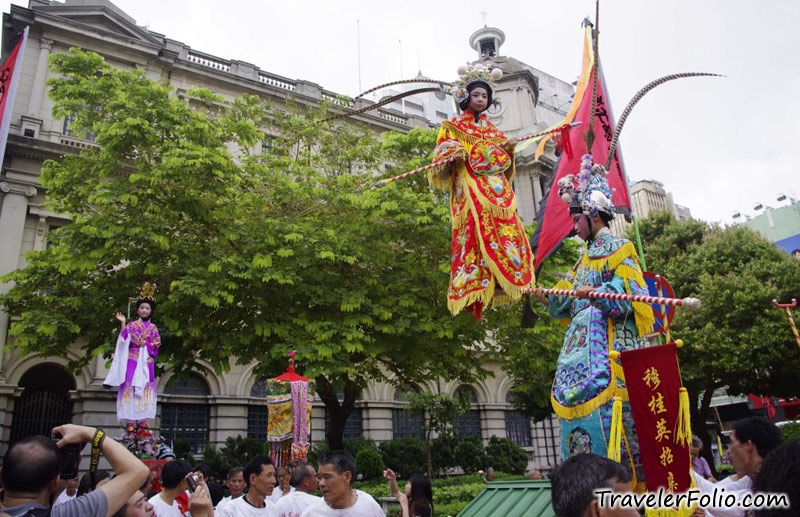
Another interesting highlight of the festival was the Floating Procession or the Floating Colours as translated from Chinese (飘色). This was the first we saw children with thick make-up and folklore costumes appear to be gliding in the air!

Initially, we really couldn’t figure out how a kid was able to lift another kid with a stick for hours! Hidden under the costumes are actually rods and wires that can hold the children in an upright position. It’s really a test of endurance for the young ones who have to stand on the decorated handcarts under the hot sun, yet not forgetting to smile and wave at the crowd!

“Do you want to be the next “floating” kid?”

The Lion with the widest smile.

Put that smile on your face.

What’s the guy doing behind the Lion?

Everyone can pose with the Lion for a wild shot.

Off they went, the Lion Dance troupe.

The young Dragon Dance troupe.

The guardian and the crouching dragons…

Hardcore photographers standing on the edge to nab their million dollar shots.

At the end of the festival, everyone joins in the feast. Folks will queue up to get the food prepared by the association.

Located along Avenida de Almeida Ribeiro (San Man Lo 新馬路), the main avenue in the city centre, Leal Senado Square (Portuguese: Largo do Senado) is a living museum. It is part of the UNESCO listed “Historic Centre of Macau”.

Enclosed by pastel-coloured, neoclassical colonial architectures including the Holy House of Mercy, Macau Business Tourism Centre, Civic and Municipal Affairs Bureau Building and the Central Post Office, Senado Square has been a civic hub for centuries and is still a favourite venue for celebrations.

Experts from Portugal paved the Square with an elegant wave pattern of black and white cobblestones that were imported from Portugal, exuding a Mediterranean atmosphere.

Built in 1587 by Spanish Dominican priests, St Dominic’s Church (at Senado Square) is also enlisted in the UNESCO World Heritage Site “Historic Centre of Macau”.

With 5-10 mins of walking from St Dominic’s Church, you can get to the Ruins of St Paul’s, undoubtedly the most iconic landmark of Macau.

Read previous post: Venetian Macao
Read all posts filed under Macau.

Randomly Penang

Purple lily. I like this shot.

When you see this signboard on the heritage trail in Georgetown, Khoo Kongsi is just 200 metres ahead on the heritage trail, after Cheah Kongsi. Do drop by Cheah Kongsi along Armenian Street. The Cheah ancient property is one of the oldest Chinese clan associations in the UNESCO World Heritage Site in Penang island. Admission is free to Cheah Kongsi.

Further down Armenian Street after Cheah Kongsi and Khoo Kongsi, you will also come across Hock Teik Cheng Sin Temple. It was built in the 1850s-60s, a community temple devoted to the worship of Twa Peh Kong.

The beautiful Chinese temple rooftop.

It’s still a popular choice among tourists to explore George Town by trishaw.

A mosque is also located near the temple. Just found out from Mylo that it’s Acheen Street Mosque.

An OLD barber shop in the OLD town!

A temple altar.

A can collector.

The backyard of some houses.

M.C.A = Malaysia Chinese Association.

When this blog post title says “Randomly Penang”, I mean it. The photos in this post were taken from anywhere in Penang. This wooden horse  and carriage shot was snapped at New World Park in Georgetown. There is a hawker centre, restaurants, cafes (Oldtown White Coffee, Starbuck?) and Guardian Pharmacy within the premises.

Take an evening walk along Church Street Pier to watch sunset. The pier is established since 1897.

Rows of colourful kites on sales at a seaside near Queensbay Mall to serve the current kite-flying trend!

A mini kelong for the fishing enthusiasts!

The Penang Bridge that connects the island to the mainland. The 13.5 km iconic landmark of Malaysia is one of the longest bridges in the world.

Penang Bridge at night.

Bon Voyage!

Previous Posts on Penang in this series: Penang Sightseeing | Cheah Kongsi

Coincidence leads to an ancient property

This time, we decided to pull over the car and explore the nooks and corners of Old Penang on foot.  Unknowingly, the quiet path that we took is a heritage trail that leads to one of the oldest Straits Chinese clan associations in the core zone of the UNESCO World Heritage Site. Located in George Town, the small entrance of Cheah Kongsi is like a hidden recess along Armenian Street. The distinctive temple roof and the red-walled passageway did look inviting enough for us to step into the historic property.

As we walked into the garden, the keeper of the property appeared out of nowhere (*mysterious*) to welcome us and even offered to show us around the place. It was free entrance plus a helpful guide! The 1870s Penang-style temple is a hybrid of a Chinese temple, a Chinese courtyard mansion and a colonial bungalow.

Traditional red Chinese doors with painted figures.

The Chinese script on the wall was written by the Chinese revolutionary leader, Dr Sun Yat-sen. This used to be a meeting room on the ground floor.

We were surprised that the temple is actually located on the second level of the property instead of the ground level like most temples.

This is the temple on the second level.

The intricate design and structure of the two-storey building has an interesting blend of Chinese, Malay and European identities.

The keeper was quite amused to find me busily snapping away in the mansion and asked if I would be photographing every part of it. I told him “It’s not possible. There are so much to appreciate in this clan house; unless I can stay here.” May I?

An old antique cabinet displaying porcelain art.

Apparently, it’s a recreation room with an opium bed on the right and a Mahjong table in the centre!

An old time office. Just look at the young Queen Elizabeth’s portrait and you can guess the age of this office!

The bedroom of a Peranakan. This property seems to have something of everything!

And there is an old school in the premises too!

Stay tuned for more Penang updates!

Avatar Floating Peaks

Photos contributed by my friend, Laytin.

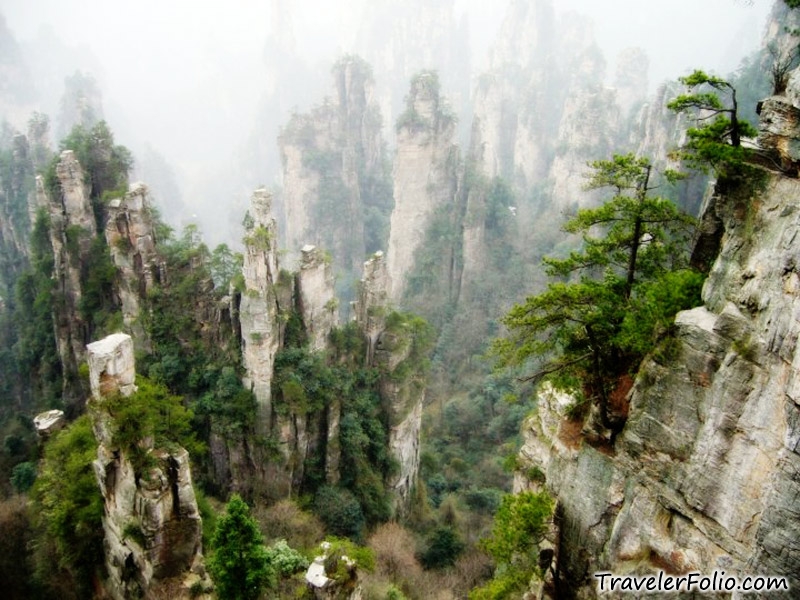
It has been in the news. Avatar claims the highest glossing movie of all time. The floating mountains in the 3-D epic movie are said to have been inspired by the craggy sandstone peaks located within Wulingyuan Scenic Area, a UNESCO World Heritage Site in Zhangjiajie, Hunan Province, China.

Not surprisingly, since the breaking of the news about the relation between Zhangjiajie and Avatar’s Hallelujah Mountains, more nature lovers especially Avatar movie fans pour into the magical peak forest to see Avatar’s fictional world of Pandora!

After all, “Pandora is far but Zhangjiajie is near.”

The “floating” peaks.

The Southern Sky Column that allegedly inspired the floating Hallelujah Mountains (“Thundering Rocks”) in Avatar.

Steep and long flight of steps amid the lofty peaks.

Laytin: Single  ( email2laytin(at)gmail.com )  V ^o^ V

The long winding road with hundreds of bends to Zhangjiajie Sandstone Peak Forest National Geopark.

Cradle Mountain Video

Video of Tassie Day 5: Cradle Mountain

Cradle Mountain is Tasmania’s natural icon. The World Heritage Area is home to an abundance of native wildlife and a popular way to see the nocturnal animals actively foraging for food at night is to embark on an evening wildlife spotlight tour. Check out the wombat and pademelon in this short clip.

Page 1 of 612345...Last »