You are now browsing all posts tagged with Travel Tips!


Preparing For Tasmania

How do you prepare for an overseas trip? Any useful travel tips for Tasmania?

The first thing that comes across my mind is the weather in Tasmania. As you know, Singapore is  tropical so we don’t experience clear-cut seasons like spring, autumn and winter. Some even jokingly say that Singapore only has three seasons: hot, hotter and hottest! Look into my wardrobe and you won’t find any sweater or woolly stuff. Psychologically speaking, I would feel too hot if I see those thick warm clothings especially on a sunny day! So, all the cold weather garments are packed in the storeroom. Now I definitely need them, better check to see if they are still in good condition!

Tasmania has four distinct seasons and the warmest months are from Dec till March, with an average summer temperature between 17 and 23 degrees Celsius. Gosh, even the warmer months are cooler than Singapore’s weather. The maritime climate can change very quickly, especially in mountain areas and the locals advise to bring at least a warm jacket and a rain jacket. I’m going to take the “onion approach“: to layer my clothing so as to warm up and peel off the layers like an onion to cool down quickly.

Wear comfy shoes for bushwalking in Tasmania and not forgetting sunscreen! Already learnt a lesson for not applying enough sunscreen during my snorkeling trip in Sabah, Malaysia and suffered a first degree sunburn.

How about a travel adaptor for battery chargers? Power points in Australia take three-pin plugs which are different from the British three-pin variety. So, bring a multi-plug adapter, or else we can only use one electronics equipment at a time. I’m going to bring a DSLR and a compact camera. Can’t wait to snap! Also, it’s good to bring a laptop along for transferring of photos from the cameras to ease up the storage spaces. You won’t know if your memory cards suddenly corrupted!

Something worth sharing: I’ve been referring to DiscoverTasmania for all the necessary info about Tasmania. When you get to the right resource, it saves time and preparation can be just as fun as the trip itself.

This is important: get a comprehensive travel insurance for a peace of mind through Chan Brothers Travel. I’ve done a list of tips to follow for an overseas trip sometime back. Feel free to check it out.

Visit this blog again on 19 Jan as I depart for Tasmania.

See you soon!

Win a 6 Days/ 4 Nights Tasmania self-drive journey and Tasmanian hampers!

- Simply follow me as I blog about my Tassie experience daily during the trip, and answer some questions at the end of my journey in Tasmania on the microsite. The one who can answer all the questions correctly will stand a chance to win a 6 Days/ 4 Nights self-drive package that’s worth S$3,500 by Chan Brothers Travel!

- Please continue to leave any good suggestions on places to visit and things to do that is unique to Tasmania in the comment box by 18 Jan’10. The top 3 recommendations will be rewarded with awesome Tasmanian mini hampers!

- 3 mini hampers will be given away to readers who JOIN Eunice’s Fanpage and SHARE on Facebook to promote the campaign (3 lucky winners will be selected).

- 2 mini hampers will be given away to readers who FOLLOW Eunice on Twitter and RETWEET to promote the campaign (2 lucky winners will be selected).

Pls refer to this microsite >> http://travelerfolio.com/devilishly-tasmania for more information.

HCMC (Saigon) Travel Tips!

Below are some travel tips and advices given by the locals and experiences gained during my trip in Ho Chi Minh City or HCMC (abbrev.), aka Saigon, in Vietnam. As I did not travel much around HCMC, please feel free to contribute your tips in the comment box here, so that I can add on to benefit everyone who is going there.

1. Crossing the roads with full of motorcars!

HCMC is the capital of motorbikes, with motorists ignoring red lights, not stopping for pedestrians on marked crossings and driving on the foot paths. We hardly saw any traffic lights for pedestrians, so most of the time, we really have to watch out for the traffic and cross carefully.

Ok, how to cross the roads in HCMC? My two-cent worth of advice:

  • If you are crossing a two-way traffic, look at your left first for any oncoming motorbikes and other motorcars, cross at a normal pace so that the motorists can sense your pace of crossing and usually, they will slow down when they are near you to let you cross the road. Then when you are near the middle of the road, look at your right for the opposite traffic. Similarly, cross steadily at a normal pace, the motorbikes will slow down to let you cross.
  • However, when a car, bus, or bigger vehicle is going to cross your path, you have to be extra careful. I will only cross the road after such vehicle crosses my path. It’s sheer madness, yet if you cross steadily like I mentioned above, rest assured that you will always make it to the opposite side of the road!

2. What to do during your stay in HCMC?

Cu Chi Tunnels

This is a must-see attraction! Cu Chi used to be a bitter battle ground for many years during the Vietnam War. It’s an underground village with an intricate network of over 200km of tunnels at Ben Dinh, 50km from HCMC. You will get a chance to crawl in the tunnels! It is recommended to take a bus tour to Cu Chi Tunnels instead of taking boat. Price for a half-day trip to Cu Chi Tunnels: USD 5 per person, inclusive of air-con bus and tour guide; exclusive of Tunnels admission and video session fees at 80,000 VND, which is around USD 5.80. Departs daily. (Read post on Cu Chi Tunnels!)

Full-day Mekong Delta

If you like boat trips, this maybe the right one for you. I have never hopped onto so many boats within a day in my life before! If you don’t live in a tropical country, you can opt for the trip with tropical fruits tasting. If you live in a tropical country like me, those fruits are as common as what we always eat. Don’t worry, no durians for the faint-hearted! … And I love durians!

Along the Saigon River, you will see typical Saigon houses at the river banks. This trip also includes a cycling session around the village. Again, if you understand the word “kampong”, it’s just like cycling in a kampong!

Price for a full-day Mekong Delta tour by boat – USD 17. This can be cheaper depending on the mode of transport that you take, eg. by bus. But it’s recommended to take the boat trip to enjoy the sceneries. Time: 7.45am to 7.00pm.

City tour

In fact, we did not join any city tour. The main attractions like Reunification Palace, the Notre Dame Cathedral, the Central Post Office, City Hall are easily accessible by taxis within District 1. You may even unknowingly cross the paths of the attractions while doing some shopping and dining in the area.

Price for the full-day City Tour: USD 8 per person, inclusive of air-con bus, tour guide and lunch; exclusive of any entrance fees. Departs daily. Time: 8.30am to 5.00pm.

Prices quoted for the above tours are based on Delta Adventure Tours packages. This tour agency is recommended by the staff at Blue River Hotel as a reliable tour agent. Another popular tour agency is Sinh Cafe. Their prices are similar too. Book the local tour packages when you are in HCMC, you will save a lot more than most online bookings in your own country.

3. Accommodation – Review on Blue River Hotel

I read about reviews on hotels in TripAdvisor and came across Blue River Hotel which is ranked at no. 2 out of 116 hotels (effectively on 28 May ‘08). So, I picked this hotel and stayed there throughout our Saigon trip. Blue River Hotel is conveniently located in the backpackers’ area in Pham Ngu Lao Str. District 1 HCMC.

The backpackers’ area, or Western Quarter, has plenty of cheaper eateries, cafes, pubs and travel agencies, all within walking distance. A plus point for budget travelers like us is – a room for two at Blue River Hotel is only USD20 (without window view). Most importantly, the hotel is clean, friendly service, has hot bath, a TV with plenty of channels like Chinese news, English movies and surprisingly, English Premier Leagues. Though it’s not the cheapest, I can say that the staffs are some of the friendliest and most helpful people I have ever met. They are just like your helpful friends. Photos of Blue River Hotel.

The famous Ben Thanh Market is about 15 mins of walking distance away from Blue River Hotel. It’s easy to get a taxi at the hotel area too. For about USD1, it will bring you around District 1.

4. Taxis in District 1, HCMC

If you are staying in district 1, three types of Taxis that you should look out for at a cheaper rate, are:

• Vinasun Taxi (white) / Tel: 8272727

• Vina Taxi (yellow) / Tel: 8111111

• Mai Ling (green/white) / Tel: 8262626

Once we took a taxi that is not mentioned above, we were charged almost double! The meter was running fast!

5. Bargains at Ben Thanh Market

After visiting a few shopping malls, boutiques and stalls, I would say Ben Thanh Market has better bargains. Some say that Ben Thanh Market is a tourist trap. But if the market is conveniently located to where you stay, I think it’s still fine to buy some souvenirs there after bargaining. I may not be a hard bargainer, but I hope the following pointers can help:

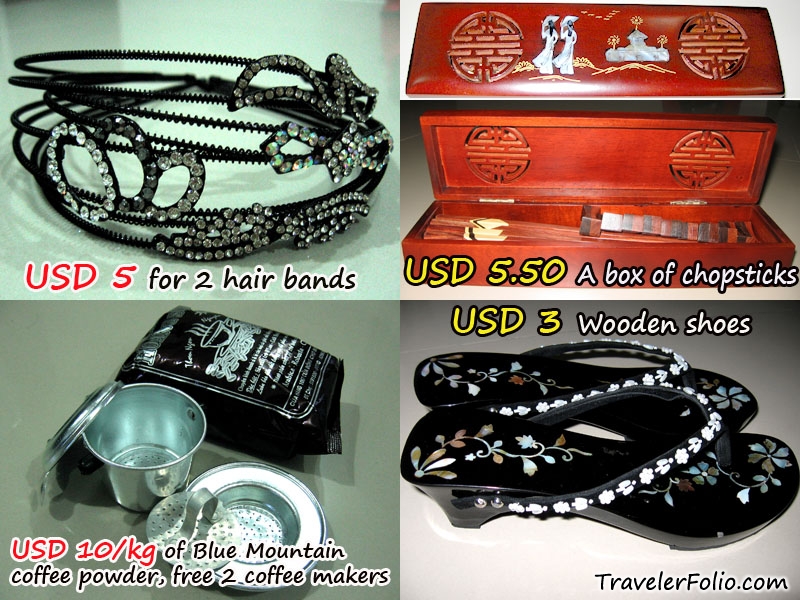
  • If you want to buy coffee powder, you may ask them grind the coffee seeds on the spot. Different coffee packages are priced differently; you just want to make sure that you are buying the “right” coffee. I could get a pack of 1kg of freshly grind Blue Mountain coffee powder at USD 10. Blue Mountain is said to be more expensive than Mocca and Arabica coffee powder. Who knows, you could get it cheaper than me.
  • If you want to buy souvenirs, bargain for the lowest price at a few stalls. Compare and go back to the one that offers the best price.
  • For ladies, a pair of handicraft wooden shoes (black with seashells designs) can cost USD 3. That was what I paid for.
  • For ladies, two hair-bands with diamond crystal designs can cost USD 5. That was the best I could get after much haggling.
  • A set of Vietnamese traditional costume (top + bottom) for a seven-year-old girl can cost USD 5. No reduction even after much haggling!
  • A handicraft wooden box with seashell design and 10 pairs of wooden chopsticks can cost USD 5.50 if not lower. I bought the set at USD 6 after much reduction from USD 10, and it was still not the best bargain.

Happy bargaining! Remember to check your goods to make sure that they are in good condition. The sellers are usually very fast in packing your goods even before you could check them for any defects! I had such bad experience with my two pairs of wooden shoes that I had to go back to Ben Thanh market the next morning to fix them.

An additional notes

It can cost as low as 12,000 VND for a 5-litre tub of pure drinking water at the supermarket. We bought an “expensive” 5-litre tub at 20,000 VND at a grocery shop along the night market near Ben Thanh Market. The night market is not as popular as Ben Thanh Market in the day. Ben Thanh Market only opens until around 6pm. Some suggest that An Dong market near Chinatown is better and bigger than Ben Thanh Market, though the latter sells certain things that you probably can’t find elsewhere, such as some handicraft souvenirs and lacquer ware.

6. Where to eat?

Just like in any non-English speaking countries, if you see an English menu, be prepared to pay more for the food. We had a meal at Pho 24, a middle-range restaurant with quite good food. One bowl of soup noodle with chicken/beef costs around 38,000 VND. Raw vegetables such as bean sprouts, lime, basil and peppermint leaves are served in a plate. You may add them into your soup.

We also had lunch at Quan An Ngon restaurant, which is located somewhere in between Nguyen Du St and Han Thuyen St.. This restaurant is featured in a popular Taiwanese variety show and is a touristy restaurant with a nice ambience. But I find it rather expensive with the Vietnamese food that it offers. The quality of the food is just average; however, you may want to try the food there. You may walk to Notre Dame Cathedral and the Central Post Office nearby.

Try the Vietnamese Coffee. It’s strong! The downside of it is, after the coffee has finished dripping from the steel container into the glass, the hot coffee turns much cooler…

Another popular restaurant to try the authentic French cuisine is Le Caprice, located on the 15th floor of Landmark Building, where you can view the Saigon River. Lunch should be around USD 30 and dinner costs around USD 50 per person. My friend had tried the food and strongly recommends this restaurant. If you are staying in the backpackers’ area like us, you can try the food and drinks at La Vang Cafe located at 169 Bui Vien St. Prices on the menu are reasonable, with good service.

Generally, female travelers like us feel safe walking along the streets in HCMC, especially in District 1. However, just like touring in any countries, using common sense is important. Avoid dark lanes and… watch out for the traffic!

If you have any, please post your suggestions about traveling Vietnam in the comment box below, so as to benefit everyone who is planning to visit Saigon, Vietnam. Thank you!

Also read 15 tips for an overseas trip!

Back to all posts on HCMC Vietnam trip.

15 Tips to follow for an overseas trip!

These are so-called “Travel Tips” that I will usually follow obediently, with real life experiences that the unlucky ones encountered during their overseas trips, including me!

  1. Travel Insurance
  2. It’s so convenient to buy a Travel Insurance, even one day before departure as your agent can buy it online and email you the policy document for printout to bring along for your trip. Of course, to avoid any unforeseeable circumstances, buy your Travel Insurance well in advance to get the original policy document mail to you before your trip.

    Travel Insurance will cover you for any medical expenses should you be involved in an accident or fall sick and require hospitalisation. Being hospitalised in a foreign country is no joke Okay! The medical cost would be very high (no medical subsidy for non-residents)! I know of a guy, who does not believe in insurance despite that his wife is an insurance agent, was hospitalised in Hong Kong due to food poisoning and spent more than S$10k on the hospital bills! He didn’t buy any travel insurance.

    Another good point is, even after you return to your country and you see a doctor, you can still claim the medical cost (MC) as long as it is within 7 days from the date you reach your country; I had claimed that before too. Read through your policy and be clear of what are covered.

  3. Photocopies of important documents
  4. Leave copies of your important documents such as passport, tickets, driver’s license, medical documents and so on with your family or friends at home for back-up in case of an emergency. Also leave copies of your itinerary at home so that you can be contacted in an emergency. If possible, with the permission of your travelling partner, leave his/her contact number at home in case your family can’t contact you in an emergency.

    Make two copies of your passport identification page. This will facilitate replacement if your passport is lost or stolen. Leave one copy at home with your family or friends. Carry the other with you in a separate place from your passport.

  5. Familiarise with the local laws and customs of your destination countries
  6. Abide to the local laws since we don’t want to get ugly with the local police! Another thing worth to mention and that actually happened to me, was to make sure you understand how the metro ticket systems work in your destination countries, especially where you don’t understand their official languages well. For example, different European countries have their own metro ticketing system. We took it for granted that the train system were similar after traveling to six different countries in a row and we got a heavy fine for neglecting the rules and regulations of the metro tickets in Italy on the last day of our sightseeing trip in Europe! (Read how we got fined in Rome)

    It’s good to follow the local customs to show respect and good mannerism to the local people. For instance, especially ladies, do not wear sleeveless and shorts when entering a religious ground where it is forbidden do so.

  7. Deal with authorised money changers
  8. I heard of a British friend who got cheated for getting very low currency exchange rate when he was being told by an unauthorized money changer that it was not possible to enter Malaysia from Thailand without Malaysia currency.

  9. Beware of counterfeit money
  10. Due to the unfamiliarity with the local currency, tourists are always an easy target to get counterfeit money, especially when getting back the loose change. A number of tourists in my previous China tour group got counterfeit money in Sichuan province, China. My brother got the counterfeit money from a hawker selling lots of souvenirs right at the entrance of the Sichuan Giant Pandas Sanctuary. Try to spend your bigger dollar in a reputable retail outlet instead.

    Additional note: For RMB, if you scratch Chairman Mao’s shirt you will feel raised lines; there will be raised lines on the right side of the bill, so scratch them and feel them. You can also buy a pocket light (15 RMB) that will light up an invisible number on the bill.

  11. Identifying your luggages among other similar designs
  12. Put identifying markings on your luggages such as bright coloured tape. I would tie my luggage handle with a bright coloured ribbon. Do not attach any nice dangling key chain on your luggage as the key chain is likely to be snapped during the transportation process at the airports. I lost mine.

  13. Do not pack valuables in check-in luggage
  14. A friend packed a nice jewellery box into his luggage and check in at an airport in Nepal. It went missing. There are many such incidents about missing valuable items in check-in luggages. Better be safe than sorry.

  15. Make sure that your passport is valid
  16. It’s safer that your passport is at least valid for more than six months from the day you travel. A friend going to Taiwan was asked to turn back when her passport validity was only around six months.

    Check with the immigration officer if he did not stamp your passport when you are permitted entry to the country, just in case it is necessary to obtain the entry stamp and the officer overlooked it.

    Nowadays, you may need to scan your fingerprints during the passport verification at the immigration counter. My hands can be very dry after spending hours in the air-conditioning and the scanning machine might not be able to read my fingerprints. So, I will apply hand moisturizer and since then, my fingerprints can be easily captured by the scanning machine.

  17. Be ready to answer questions at the immigration counter
  18. The immigration officer may ask you where you are going and staying during your visit in the country. I think it’s good to carry your itinerary with you just in case you need to refer to it. The officer may also want to know if you carry enough money to spend for your whole trip. Carry some cash, traveller’s cheques and/or credit cards with you to show him. This usually works for me.

  19. Be aware of what is happening around you
  20. When you are in crowded places, train and bus terminals, be aware of suspicious people around you. When we were in a train station in Prague, my friend went to the ticket booth to check out the sale of tickets. A man who was also wearing uniform (could be fake uniform of the train station) approached him at the queue and beckoned him to go somewhere, perhaps with a better deal to offer. My friend ignored the man as it was strange that why wouldn’t the man let the ticket counter to serve him instead?

    At the same train station, when another friend was withdrawing money from ATM, two suspicious men were standing close to us and watching over our shoulders. At that point, we had to act like security guards for our friend! When we left, the two men also left that area. Obviously, they were not there to withdraw money! (Read unpleasant travel experiences.)

    We had a friend who lost his camera in Vienna when he placed the camera next to him in a restaurant. He could recall that a man stood near him and flipped his coat. That should be when his camera was stolen. Sounds like magic! Gone was not only the new camera, but the precious photos taken during the whole trip with his girlfriend.

  21. Avoid being a target of crime
  22. Try not to wear conspicuous clothing and expensive jewellery. Try to blend in and dress conservatively. Also, try not to hang your camera around your neck and with a map on your hand; after all, you already look like a tourist! Do not draw out a large amount of cash from your wallet to draw unnecessary attention to yourself. Think about where you are going that day and carry only enough cash, traveller’s cheques and/or credit cards for the day and keep the rest in the hotel safe. This is to limit any loss in case bad things do happen to you.

    Keep a list of your credit cards and traveller’s cheques company phone numbers just in case you need to cancel them in the event of loss or theft. You can call your credit card company for a temporary increase of the credit limit (subject to company’s approval) so that you don’t need to bring too many credit cards along.

  23. Special Deals? Be caution!
  24. We were cheated with fake coach tickets at Larkin Terminal in Johor, Malaysia when we were on a snorkelling trip to Pulau Tioman. We were then queuing up to buy coach tickets to Mersing jetty when a man approached us at the queue and convinced us with a better deal by taking his coach. He showed us his receipt book, with company address and stamp while trying to convince us to buy his coach tickets. He appeared to be very friendly and chatted with the ticket officer at the counter where we queued up. Without much suspicion, we bought his tickets. On the day of departure, we couldn’t contact him and his company. Our designated coach never arrived. As a result, we paid for an air-con taxi to take us to Mersing. Apparently, the air-con was not functioning well and we were perspiring profusely throughout the next two hours of journey!

  25. Never help unknown parties to carry things out of the country
  26. This may sound more like a common sense but it’s noteworthy. Do not help a stranger to carry his/her baggage across the immigration checkpoints, even he/she looks like a helpless person. Refer him/her to the immigration officer for help instead. You will never know what is packed inside. It could be a banned item and you won’t want to deal with the immigration officers too much!

    Also, try not to carry an open bag to prevent anyone from slipping banned stuff into your bag when you are approaching the immigration checkpoints.

  27. Beware of well-dressed people who happen to be around
  28. Good news is there are usually more good people around! But if a person who happens to be around you and happens to speak your language, starts chatting and gets very friendly, he/she could have other hidden motives. That is the way they win your confidence.

    When we were in Europe, we had to start our conversation with them by asking “Do you speak English?” Yet, when we were in Prague, a woman who looked like a European approached us in the old town square and asked us for help in English. It was peculiar at that point of time as we were obviously Asian tourists and there were so many locals around, why would she want us to help?

    Once when we were eating at a food court in Malaysia, a well-dressed Chinese man with strong accent of Chinese from mainland China approached us for help too. He smiled and said that he couldn’t find his relatives in Malaysia and had no money left. That was weird! If he was lost, he should go to the nearby police station.

    When we were walking along the streets in China, a group of rickshaw drivers were very persistent and following us around and around. When it was getting late, our group took their ride back to the hotel. Instead, the drivers detoured and took us to a shop selling jades! We insisted to go back to our hotel. Fortunately, there was no ugly scene involved. (Read posts on Sichuan, China)

  29. Your local embassy
  30. Your embassy is there to assist you if you lose your passport or are in trouble. Therefore, it’s good to make a note of the location and contact number of your local embassy. In case anything goes wrong, such as a disaster during your visit in that country, call home as soon as you can to let your family/friends know that you are safe and sound.

Last but not least, enjoy your trip without worries! If you have any travel tips to share, please email: travelerfolio@gmail.com and I will be pleased to publish them for you here! Alternatively, feel free to leave your comments here!

You may also read HCMC (Saigon) Travel Tips.