Posted on 29 October 2002
This is an interesting temple where my Hangzhou friend told me he and his school mates would go there to pray before they sat for his exams and his prayers were answered… Lingyin Temple is located in Hangzhou (杭州), Zhejiang province and is one of the largest and wealthiest Buddhist temples in China. It was founded in 328 AD during the Eastern Jin (晋) Dynasty.

A famous figure that we know of from Hong Kong and China drama series was a Buddhist monk called Daoji (济公), who was known for his eccentric behaviour yet with a kind heart for helping people. Unlike traditional monks, he ate meat and drank wine. The monks were fed up with his behaviour and expelled him from the monastery. From then, he roamed the streets and helped needy people.

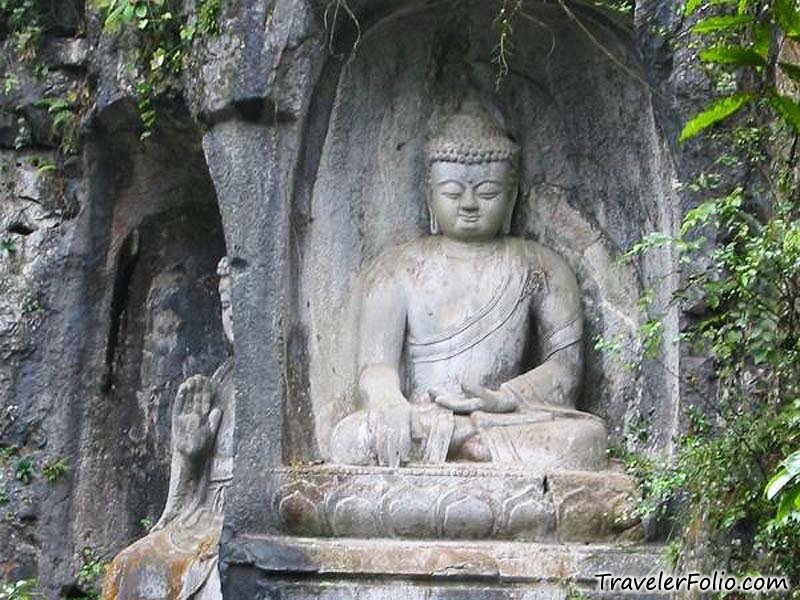
Stone carvings at Feilai Feng, translated as “Flying Peak”; also a passing point for the pilgrims of the “Journey to the West” (西遊記) - one of the Four Great Classical Novels of Chinese literatures.
Read the full story
Posted on 28 October 2002
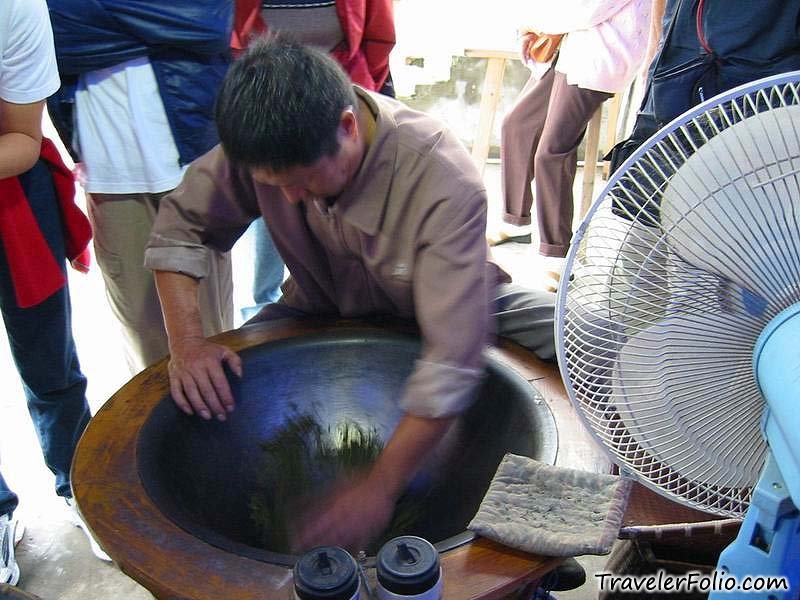
In Hangzhou (杭州), don’t forget to try some Longjing (Dragon Well) tea (龙井茶). It is a famous variety of green tea from Hangzhou and is produced pan fried by hand to stop the fermentation process, which refers to drying of the freshly picked leaves, resulting in enzymatic oxidation. This means Longjing tea leaves are unfermented and has the highest concentration of catechins among teas.
We visited Mei Jia Wu Tea Village (梅家坞) for its Longjing Tea. Mei Jia Wu Longjing tea has a light nutty aroma, smell of fresh leaves, very smooth taste and a pleasant flowery aftertaste. The tea leaves are green, flat and slender. One container of half a catty (斤), equivalent to 500 grams in China, costs around S$50 (about US$36). Not cheap. The promoter motivated us by stuffing and compressing the tea leaves into one container, to make it look like we got more tea leaves! But remember to tape the container cover, as the “pressured” leaves might “pop” the cover and create a mess in your bag!

This man must have mastered the skill of iron hand! He was frying the tea leaves with his hand.


Next: West Lake, Hangzhou!
Posted on 27 October 2002
上有天堂,下有苏杭 - “In heaven there is paradise, on earth Suzhou and Hangzhou.” It is a famous Chinese proverb. Hangzhou is well-known for its enchanting natural scenery, with Xi Hu (西湖), literally “West Lake” as the most noteworthy location.
The West Lake is said to be the incarnation of Xi Shi (西施), the one of the renowned four beauties of ancient China. “沉魚落雁, 閉月羞花” is used to compliment Xi Shi’s extreme beauty, literally means while leaning over a balcony to look at the fish in the lake, the fish would be so mesmerized that they forgot to swim and sunk; birds would forget to fly and fall; the moon would fade and flowers would close their petals in shame! So you can see how Xi Hu was associated with a large number of romantic poets, philosophers and national heroes in ancient time. One of the famous heroes, a patriot called Yue Fei (岳飞), was buried nearby and we visited the Mausoleum later on.
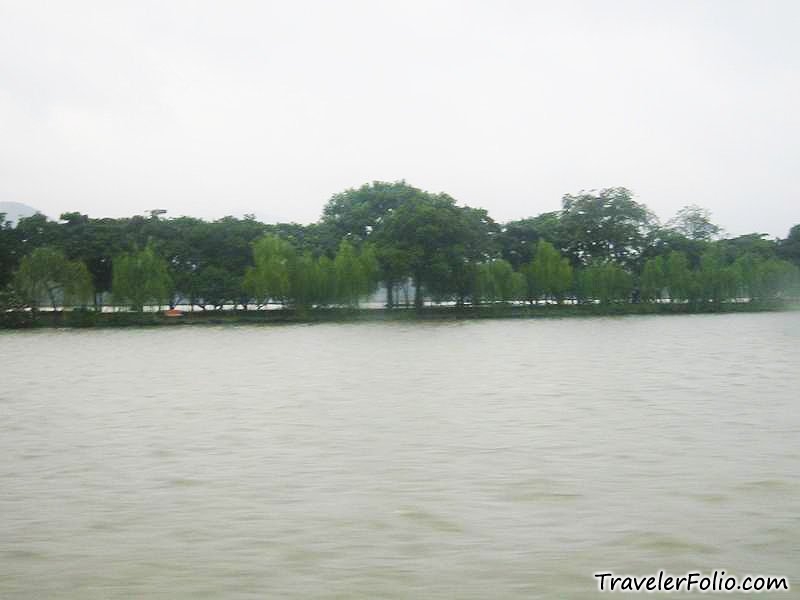
Xi Hu is surrounded by plenty of weeping willows swaying in the breeze. It was drizzling and we were cruising on the boat. If the rain was too big with thunder storm, we might not be able to get on the boat for the cruise.

The Thunder Pagoda has a legend about Lady White, a white snake who had magical power and fell in love with a man. She was trapped under the Thunder Pagoda by a monk later on… The Story is so popular that it is performed in Chinese operas, movies, comics, novels, cartoon and even PC games!

Read the full story
Posted on 26 October 2002
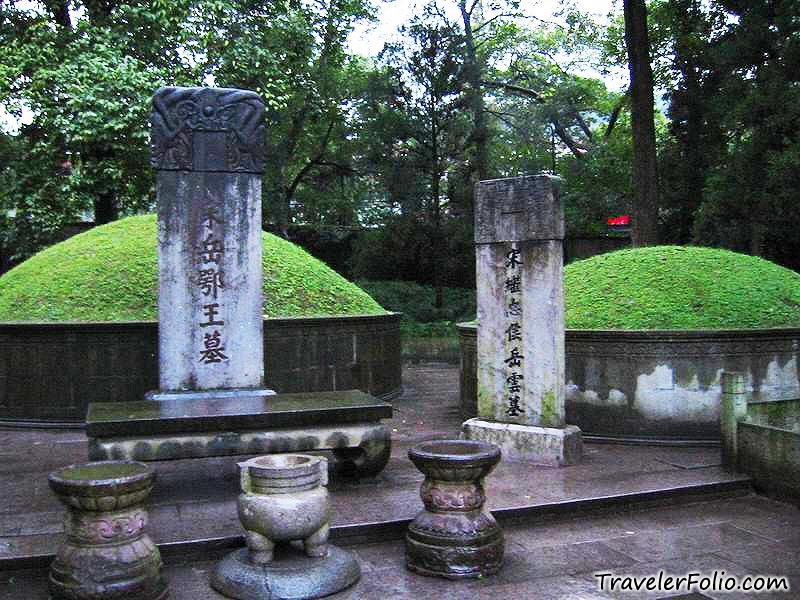
The Mausoleum of General Yue Fei (岳飞), situated near the West Lake, is a memorial built in honor of the great general Yue Fei who had won many wars against the armies of the Jin Dynasty. He was politically executed by traitors and since then, he has evolved into the role model of loyalty in Chinese culture. Above the statue of Yue Fei is a tablet bearing an inscription in his very own handwriting that says, “Restore Our Lost Land”, or literally means “Give me back my rivers and mountains”.

Yue Fei’s mother wrote four words on his back: 盡忠報國 (jin zhong bao guo), means “serve the country with utmost loyalty“.

The four kneeling iron statues are Qin Hui (秦桧), his wife Lady Wang (王氏) and two of Qin Hui’s subordinates, Moqi Xie (万俟軼) and Zhang Jun (張俊). They were made to kneel before Yue Fei’s tomb, and for centuries, these statues have been spat, urinated, cursed, and Jacky even touched one of them! Yucks! Now these statues are protected as historical relics. There is a poem that reads, “the iron was innocent to be cast into the statues of traitors” !
Read the full story